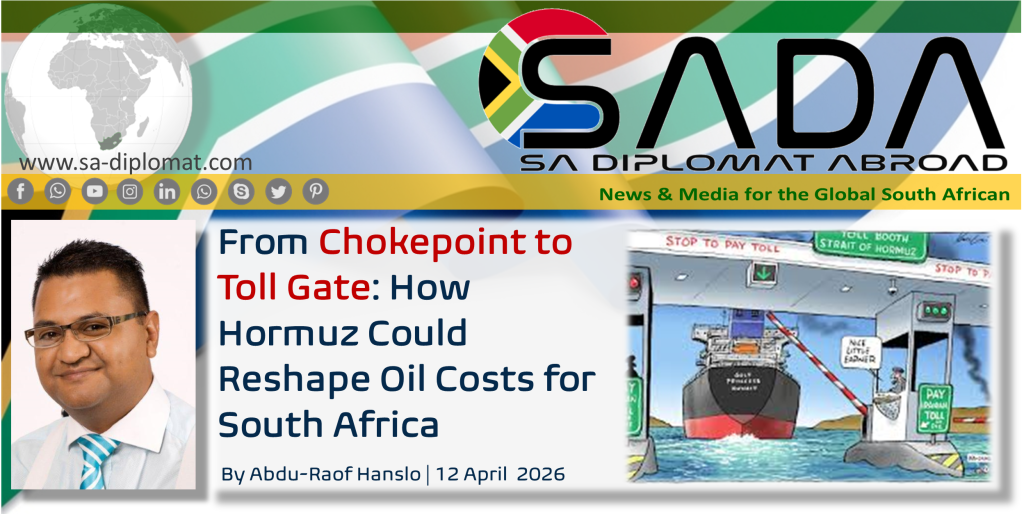
The reopening of the Strait of Hormuz would ordinarily signal relief for global oil markets. As one of the world’s most critical energy corridors through which an estimated 20–21 million barrels of oil per day (roughly 20% of global consumption) passes, any restoration of flow is typically welcomed by import-dependent economies. However, in the current geopolitical climate, a reopening does not necessarily equate to stability. If conflict in the region persists and Iran introduces toll charges for vessels transiting the Strait, the global oil landscape and by extension the outlook for South Africa becomes far more uncertain.
When a disruption in the Strait is lifted, a backlog of oil shipments is almost inevitable. During periods of closure or restriction, dozens sometimes over 100 tankers carrying millions of barrels of crude can be delayed. Once passage resumes, these vessels move through in concentrated waves, creating a temporary surge in supply. This initial release can ease immediate shortages and improve feedstock availability for refineries worldwide. Yet such relief is often short-lived. Port congestion, logistical constraints, and scheduling bottlenecks mean that the backlog typically clears within two to four weeks, after which normal supply-demand dynamics resume. In a stable environment, this would contribute to price moderation. Under conditions of ongoing conflict, however, the benefits are significantly diluted.
The continuation of hostilities in the region introduces a persistent layer of risk that extends beyond physical supply. Even with the Strait open, markets remain sensitive to the possibility of renewed disruptions, attacks on shipping infrastructure, or sudden escalations. Historically, geopolitical tensions in the Gulf have added a $5 to $15 per barrel risk premium to global oil prices, depending on severity. This uncertainty is reflected in higher insurance premiums war risk insurance for tankers can rise by 200% or more during peak tensions and increased security costs. Consequently, while more oil may be flowing, it does not necessarily become cheaper.
The potential introduction of toll fees by Iran further complicates the situation. Should vessels be required to pay for safe passage through the Strait, the waterway effectively transforms from an international transit route into a controlled and monetized corridor. Estimates suggest that such tolls could range from $1 to $2 per barrel, or alternatively $1 million to $2 million per tanker, depending on cargo size. Given that a typical Very Large Crude Carrier (VLCC) transports around 2 million barrels, this translates into a direct cost increase of roughly $0.50 to $1 per barrel at minimum, before additional insurance and security costs are factored in. These costs would be passed along the supply chain, raising the global baseline price of oil.
This toll system could also influence the pace at which the backlog clears. Some operators may delay transit in an effort to avoid or negotiate fees, while others proceed at higher cost. The outcome is an uneven and potentially restricted flow of oil, rather than a smooth normalization. Instead of a clear transition from shortage to surplus, the market may experience a prolonged period of partial supply recovery combined with elevated pricing.
For South Africa, these dynamics present a significant economic challenge. The country consumes approximately 500,000 to 600,000 barrels of liquid fuels per day, while producing virtually no crude oil domestically. More than 80% of its fuel requirements are met through imports, either as crude oil for refining or as finished petroleum products. In recent years, domestic refining capacity has declined sharply, with several refineries either closed or operating below capacity, increasing reliance on imports.
Fuel prices in South Africa are closely linked to international benchmarks such as Brent crude, as well as the rand-dollar exchange rate. A sustained increase of $10 per barrel in global oil prices can translate into a rise of roughly R1.00 to R1.50 per litre at the pump, depending on currency movements and other cost factors. If tolls and geopolitical risk add even $5 to $10 per barrel to global prices, South African consumers and businesses would face noticeable cost pressures.
In the short term, fuel prices are likely to remain high and volatile, reflecting both the earlier supply shock and the added costs associated with risk and transit. Logistics disruptions may also affect delivery schedules as global shipping adjusts to new constraints. Over the medium term, while the clearing of the backlog may improve supply availability, any price relief is likely to be limited. The continuation of conflict, coupled with the introduction of toll fees, would act as a ceiling on how far prices can fall.
The broader economic implications for South Africa are significant. Higher fuel prices feed directly into transport costs, food prices, and inflation, placing pressure on households and businesses alike. Sectors such as mining, agriculture, and logistics which are heavily dependent on diesel, are particularly exposed. Persistent fuel inflation can also complicate monetary policy, potentially limiting the ability of the central bank to reduce interest rates in support of economic growth.
In essence, the reopening of the Strait of Hormuz under these conditions represents not a return to normality, but the emergence of a new operating environment for global oil markets. Supply may resume, but under tighter control, higher costs, and persistent geopolitical risk. For South Africa, this translates into continued exposure to elevated fuel prices, increased inflationary pressure, and ongoing vulnerability to external shocks.
The situation underscores a broader reality: in today’s interconnected energy system, the movement and pricing of oil are shaped as much by geopolitics and strategic control as by traditional supply and demand fundamentals. Even as tankers begin to move again, the true cost of oil will ultimately depend on the conditions under which they are allowed to pass.
Disclosure
The information provided in this article is for general informational and educational purposes only and does not constitute financial, investment, or professional advice. All views and opinions expressed are those of the author and are based on personal judgment at the time of writing.
While every effort has been made to ensure the accuracy and reliability of the information presented, no representation or warranty, express or implied, is made regarding its completeness, accuracy, or suitability. The author accepts no responsibility or liability for any errors, omissions, or for any losses or damages arising from the use of this information.
The author may hold positions in, or have interests in, financial instruments or assets discussed in this article, which could present a potential conflict of interest.
Readers are encouraged to conduct their own research and consult with a qualified financial advisor or professional before making any financial decisions.